


Website
What should a business website include? A guide before you hire
Before you hire a web designer: the pages a business website needs, who owns the accounts, speed, search visibility, privacy, what drives cost and what to ask.
- Author
- Mücahit Arslan · Co-founder
- Published
- Reading time
- 10 min read
Contents
- What is a business website for?
- What should the website achieve?
- Which pages should a business website have?
- Who should own the domain, hosting and accounts?
- Should you use a template or a custom design?
- Who writes the content?
- How fast should the website be?
- How will it be found on Google and in AI search?
- How should privacy, cookies and tracking be handled?
- Why does accessibility matter?
- What does a business website cost?
- What happens after launch?
- What questions should you ask when hiring a web designer?
The most important thing to get right when you commission a business website is not how it looks but what it is for: who it serves, what visitors should do, and which searches it needs to be found for. Four foundations follow from that: a separate page for every service, a domain and accounts registered in your name, pages that load fast and work well on a phone, and privacy-compliant forms and cookies. When you compare quotes, don't compare the totals; check whether each of these is actually in the quote.
What is a business website for?
A business website is a company's official home online: who you are, what you do and how to reach you. Unlike an online shop, it doesn't sell directly; it builds trust and generates enquiries. A good business website does three jobs at once:
- It builds trust. Anyone who hears about you through a recommendation, an ad or a business card looks at your website first. An outdated, slow or incomplete site works against you before a conversation has even started.
- It gets found. It appears in Google and in AI answers for people searching for what you offer.
- It turns visits into enquiries. It leads visitors to a quote request, a booking, a phone call or an email.
Each of these jobs needs its own decisions. The sections below take them in the order you will meet them when hiring someone to build your site.
What should the website achieve?
The first decision is not the design but the goal: what should visitors do on the site? For a dental practice that is booking an appointment, for a law firm an initial consultation, for a manufacturer a quote request, for a tradesperson a phone call.
Once the goal is clear, many decisions follow naturally. If it is bookings, the booking button is visible on every page. If it is enquiries, the form is short and sits at the end of each service page. If it is calls, the phone number can be dialled with one tap on a phone. A website without a goal says a little about everything and leads visitors nowhere.
Raise this in the first meeting. A good agency will ask you, before showing any design examples: “How many enquiries do you expect a month, and where do they come from today?”
Which pages should a business website have?
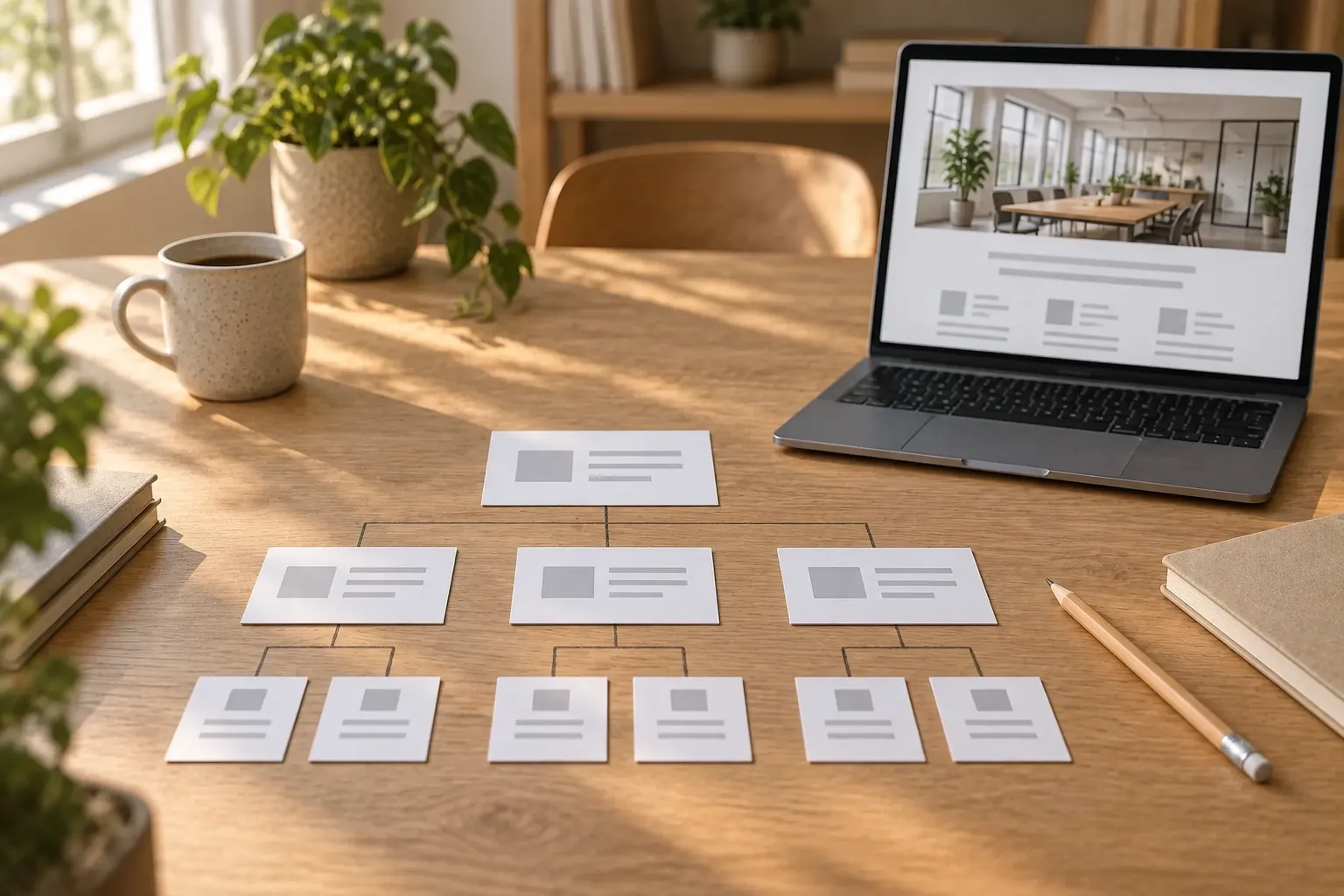
The pages a business website needs depend on the business, but this structure works for most:
| Page | Job |
|---|---|
| Homepage | Explains what you do in seconds and points visitors to the right page |
| One page per service | Meets people searching for that exact service; Google and AI answers learn about you from these pages |
| About | Shows who does the work, with what experience and approach |
| Case studies or projects | Shows your work, with the client's name if they agree, otherwise by sector |
| Contact | Address, phone, email and, where relevant, a map and opening hours |
| FAQ or articles | Answers the questions customers actually ask |
| Legal pages | Privacy notice, cookie policy and whatever else your country requires |
The gap we see most often: every service crammed onto one page. A “Services” page listing ten offers in two sentences each fully answers nobody who is searching for one of them. When a dental practice explains implants, orthodontics and cosmetic treatment on separate pages, each page can be found for its own search and answer the questions patients have about that treatment. Why this matters even more in local search is covered in our article on why local SEO matters.
Who should own the domain, hosting and accounts?
You should. The domain, hosting, website admin, Google Analytics, Search Console and any ad accounts should be registered in your company's name, with the agency given access as a manager.
This is the point least discussed in quotes and the one that causes the most trouble later. A business whose domain is registered to its agency has to fight to get its own address back when it changes supplier. A business whose Analytics account sits with the agency loses years of data. That is why we set up every account in the client's name from day one; when we stop working together, the client simply removes our access.
Ask for it in writing: “The domain, hosting and all accounts will be registered to our company, and we will hold administrator access.”
Should you use a template or a custom design?
A template is fast and cheap, and many website packages are a template dressed in your logo and colours. The catch is twofold: your business looks like every competitor using the same template, and templates usually ship with dozens of features you never use, which slow the site down.
With a custom design, the page structure, content and visual style are built around your services. It costs more and takes longer, but it tells your story more accurately.
For most businesses, the best route lies in between: a solid, widely used platform such as WordPress, with page sections designed specifically for you. Your team can add content, the platform stays up to date, and the site doesn't look like a copy of a template.
Who writes the content?
When a business website goes live usually depends on the content rather than the development. A typical business website takes four to eight weeks, on the condition that the text and images arrive in the agreed week. If a single section is late, the whole timeline slips.
There are three routes, and each has its price:
- You write it yourself. It saves budget but not time. The agency should tell you what each page needs to cover and roughly how long it should be.
- The agency writes, you approve. The timeline is safer, and the text is written around real search terms.
- Images. Stock photos are quick but look the same everywhere. Real photos of your team, premises and work build noticeably more trust.
If your site will be in several languages, this matters even more: translated text misses the terms readers in each language actually search for. Our guide to a multilingual website for Germany goes into this in detail.
How fast should the website be?
Google indexes and ranks websites based on their mobile version, so a site should be designed for phones first. For speed, Google sets clear benchmarks. The Core Web Vitals measure three things:
| Metric | What it measures | Good threshold |
|---|---|---|
| LCP (Largest Contentful Paint) | How quickly the main content appears | 2.5 seconds or less |
| INP (Interaction to Next Paint) | How quickly the page responds to a tap or click | 200 milliseconds or less |
| CLS (Cumulative Layout Shift) | How much content jumps around while loading | 0.1 or less |
Google recommends hitting these at the 75th percentile of page loads. Ask the agency to show you all three figures at handover. On our own website, automated tests check speed and accessibility on every change; if a test fails, the change can't go live. Not every business website needs that level of testing, but it should be measured at handover.
How will it be found on Google and in AI search?
There is no secret to ranking; Google's own starter guide says as much. What makes the difference is content that answers the questions people are actually searching for.
In practice, that means:
- Every service has its own page, written in the words people use when they search.
- Every page has a unique, descriptive title and a readable address.
- The site's structure and internal links let Google find every page.
- Your business details, such as name, address and phone number, match across the website, your Google Business Profile and the structured data.
There is no special trick for AI answers either. Google says there are no additional requirements to appear in AI Overviews or AI Mode; the same SEO fundamentals apply. What sets pages apart is answering in the first sentence and offering knowledge that isn't available elsewhere. We explain this in our guide on how to show up in AI search.
How should privacy, cookies and tracking be handled?
As soon as your website has a contact form, a newsletter sign-up or an analytics tool, you are processing personal data. Under the GDPR, and the UK GDPR, your privacy notice must explain which data you process, for what purpose, on what legal basis and who you share it with.
Cookie rules vary by country, but in the EU, analytics and advertising cookies may only run after the visitor consents. In practice that means a consent banner that genuinely blocks tracking until consent is given. On our own website, Google Analytics and the Meta Pixel only load after consent.
Set up measurement from the start. It is the only reliable way to see, after launch, which pages bring enquiries and where visitors come from.
Why does accessibility matter?
An accessible website can also be used by people with visual, hearing or motor impairments: keyboard navigation, screen reader support, sufficient colour contrast and descriptive text for images. The international benchmark is the W3C's WCAG 2.2.
In the EU, accessibility is now a legal requirement for certain consumer-facing digital services, such as online shops. A purely informational business website usually isn't covered, but accessibility still pays off: an accessible site reaches more people, is easier to use on a phone and is better understood by search engines. Ask which level of accessibility the quote aims for.
What does a business website cost?
Business website prices vary widely, because very different work is sold under the same name. The cost is driven by:
- the number of pages and languages
- a template, a custom design on an established platform, or a fully custom build
- who writes the content and supplies the images
- features such as forms, online booking, multiple languages, or connections to a CRM or other systems
- whether search optimisation and measurement are part of the job
On top come the yearly domain and hosting, and optional technical maintenance. Two quotes with a similar total can include some of these and leave others out. So compare the line items rather than the total, and ask for an itemised quote. We don't sell fixed packages; after a short initial review we send a proposal with every item listed.
What happens after launch?
A business website isn't finished on launch day; that's when it starts working. After launch there are three jobs:
- Technical maintenance. Updating the platform and plugins, security checks and regular backups. Neglect this and within a few years the site becomes slow and vulnerable.
- Keeping content current. New services, projects, team changes. On a well-built site your team can do this without breaking the design; ask for a short handover session.
- Measuring and improving. Which pages bring enquiries, and where do visitors drop off? Checking this every few months costs far less than another rebuild.
You don't have to leave maintenance with the agency. If you do, you shouldn't be tied to a minimum contract term.
What questions should you ask when hiring a web designer?
Ask every agency or designer you get a quote from the same questions. Putting the answers side by side tells you more than putting the prices side by side:
- Whose name will the domain, hosting and all accounts be registered in?
- Which pages and languages does the quote cover, and who writes the content?
- How long will it take, and what does the timeline depend on?
- Template or custom design, and can we update the site ourselves afterwards?
- How will speed and accessibility be demonstrated at handover?
- Are search optimisation and measurement included?
- How will the privacy notice and cookie consent be set up?
- How does maintenance work after launch, and is there a minimum term?
In our own projects we go through these questions with the client in the first meeting, and the proposal and timeline come out of the answers. A business website built right carries your business for years; one built wrong costs a little more every year.
Frequently asked questions
It depends on the number of pages and languages, whether a template or a custom design is used, who writes the content and supplies the photos, and which features are needed, such as forms, online booking or a CRM connection. On top come the yearly domain and hosting, and optional maintenance. Two quotes with a similar total can contain very different work, so compare the line items, not the total.
A typical business website goes live in four to eight weeks. The timeline usually depends on content rather than development: if the text and images arrive in the agreed week, the plan holds; if a single section is late, everything shifts. More pages, more languages and special features add time. Ask for the timeline in writing, together with what it depends on.
A template is fast and cheap, but it makes your business look like everyone else using it and often slows the site down with features you never use. A custom design costs more and takes longer, but the structure and content are built around your services. Many businesses do best in between: a solid, widely used platform with page sections designed for you.
For a simple one-page presence, yes: AI website builders produce a draft in minutes. But a business website is more than how it looks. It needs a sensible page structure, content written around real searches, fast loading, accessibility, a privacy notice and measurement set up properly. AI speeds up parts of that work; the decisions and the checking still need a person.
You should be able to, and you should ask for it in the quote. On a well-built business website, your team can add news, projects or new colleagues without breaking the design, because pages are built from fixed sections. Ask for a short handover session. Technical maintenance, meaning updates, security and backups, is a separate job that you can leave with the agency.
At minimum: a homepage that explains what you do in seconds, a separate page for each service, an about page, examples of your work, a contact page and the legal pages your country requires, such as a privacy notice. Behind the scenes it needs fast loading on phones, content written around real searches, measurement, and a domain and accounts registered in your company's name.
Questions about this topic?
Write to Mücahit Arslan directly. You will be talking to the person who wrote this article.