


AI and automation
AI automation for small businesses: which processes actually pay off
Which processes a small business can automate with AI, where it doesn't pay off, and how to work out when the set-up will pay for itself.

We build your workflows, connect your systems to each other and automate your reporting.
Discuss your projectWhere you are
The same spreadsheet to fill in, the same email to write, the same file to move. Each one is quick, but it comes round every month and nobody adds up the total.
The order is in one place, the invoice in another, the customer details in a third. Update one and the others fall behind, and soon nobody's sure which version is right.
Forms, emails, messages: each one lands somewhere different. If one slips through the net, the customer never hears back, and you only find out when they complain.
The numbers sit in different systems and get copied into a spreadsheet by hand every month. By the time the report is ready, the month it covers is long gone.
A tool was bought, used for a few weeks, then forgotten. Usually the tool wasn't the problem: nobody decided up front which job it was meant to do.
Where it pays off
However you work, we never automate anything whose rules can't be written down. And if a system that needs connecting has no API, we'll tell you in the initial assessment, so there are no surprises later.
A clinic, a salon, a workshop or a consultancy: a full calendar means the business is running, and an empty hour never comes back.
Whether you sell in a shop or online, the same order gets entered into three systems.
Trades, B2B services or project work: a job is rarely lost on the quote itself. It's lost when nobody follows up.
Invoices, delivery notes, contracts: every document that has to be read and typed in somewhere eats up time.
Scope
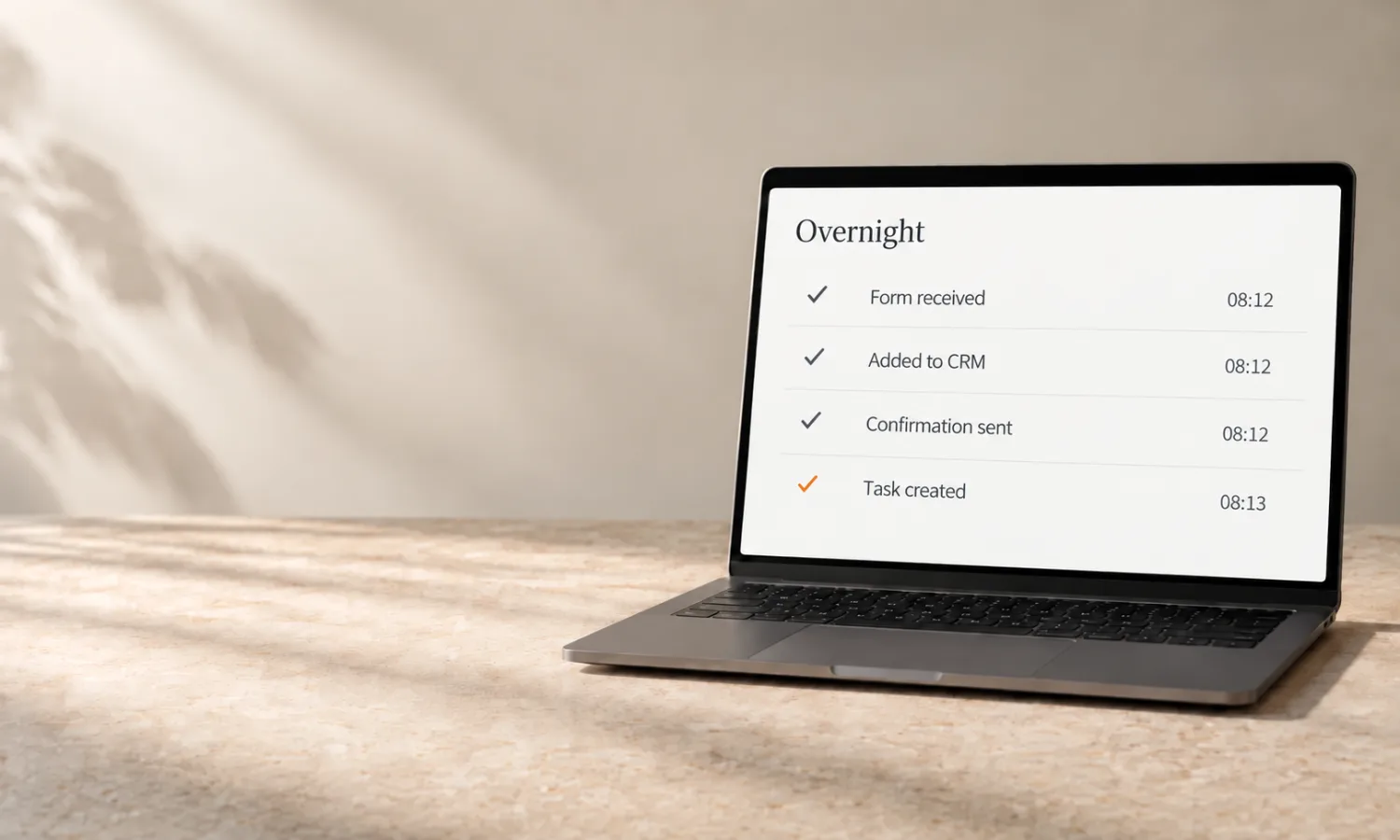
A concrete example: someone fills in the form on your website, the contact lands in your CRM, a confirmation email goes out automatically and a task is created for you. Four steps, without you lifting a finger. We apply the same pattern to whatever repeats in your business: preparing quotes, tracking orders, sending reminder emails. We build the workflows on n8n, so every step stays visible and can be changed on its own. For a process to be worth automating, it has to come round often: something weekly pays for itself within a few months, while something that happens twice a year never earns back the cost of building it. We work that out together in the initial assessment.
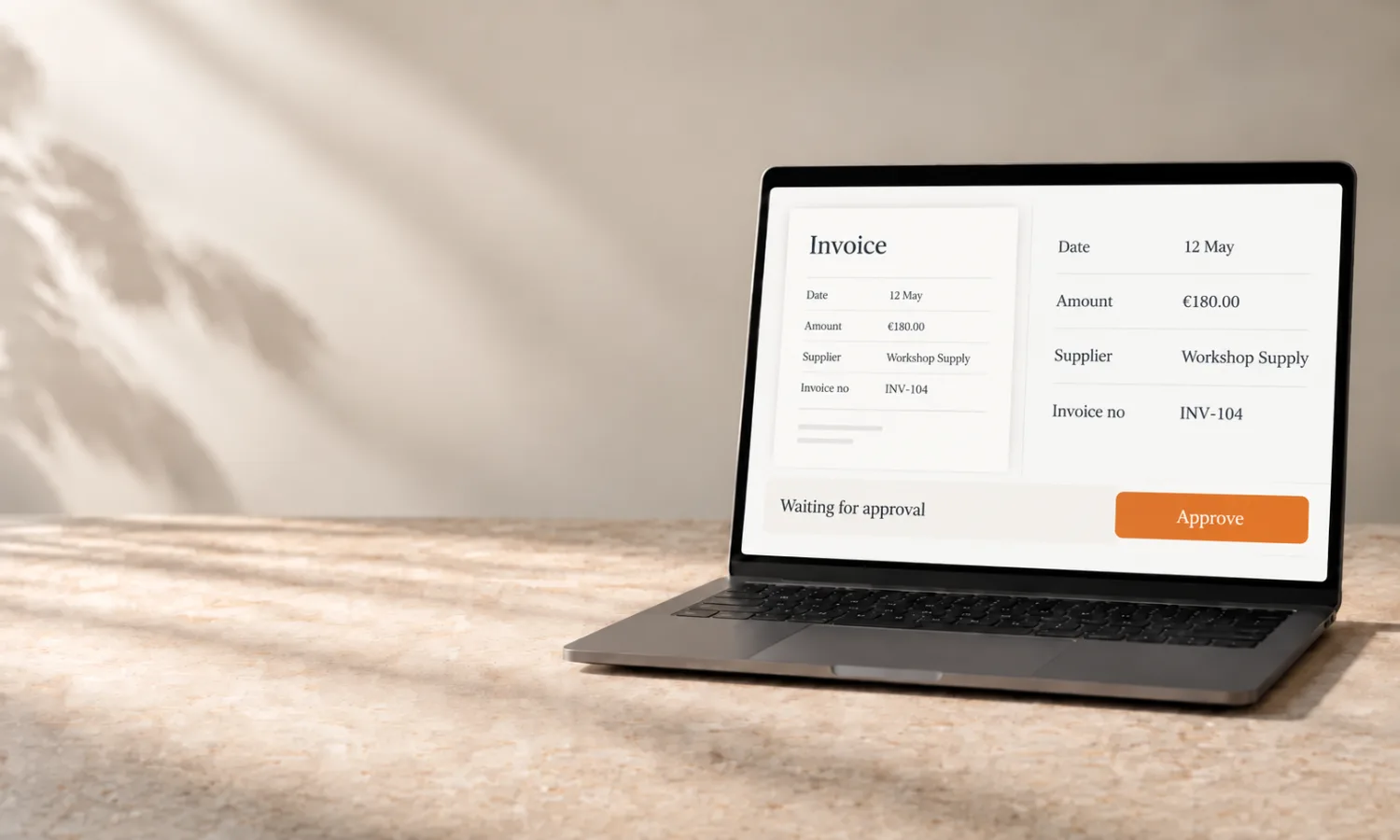
A concrete example: an order is placed in your online shop, the invoice is raised, it goes to accounting and stock is updated. Nobody types the same data in twice. We connect your website, CRM, accounting software and email tool, and settle in advance which system holds the master record, so no two systems overwrite each other. Before any of that, the data has to be put in order: the same customer entered twice, missing fields, different spellings. This step is usually underestimated and is often the longest part of the job.

AI isn't needed at every step; we use it where it actually helps. For example: reading an incoming invoice and splitting it into fields, routing a freely written enquiry to the right person, drafting replies to common questions. AI is good at reading and sorting and weak wherever judgement is needed: pulling the amount off an invoice is its job; deciding whether that invoice should be paid is yours. We draw that line when we build the workflow. Anything that goes to your customers is approved by a person, and wherever a decision would otherwise be automatic, we build in an approval step.
A concrete example: every Monday morning, last week's summary lands in your inbox on its own. The numbers are pulled from your different systems into one overview, and nobody copies anything by hand. We decide together what gets measured; nobody reads a report that measures everything. It doesn't go to everyone either, only to the person who'll act on the number. If no decision comes out of a report, it's just an automated habit.

Our approach
According to a widely cited 2025 MIT study, 95% of AI pilots in companies deliver no measurable return. Often that's because they start big and never measure. We automate one process, measure the benefit and only then roll it out further.
The biggest hurdle for automation usually isn't price; it's the question of where the data goes. Because we can run the workflows on your own server, that question doesn't come up at most steps. Where it does, you'll know in writing before we start which data goes where.
An agency that builds an automation and keeps the keys has locked its clients in. We do the opposite: the workflow sits in your account, the documentation is yours, and we'll hand both over to your team whenever you like.
Process
We sit down together and put in writing which processes repeat, how many hours each one takes a month and which are prone to errors.
From that list we pick one process: not the most time-consuming, but the one that pays off fastest. We agree up front how we'll measure it.
We build the workflow, connect it to your systems and let it run under close watch for a few weeks. Any faults show up in that time, and we fix them.
We measure the benefit. If it paid off, we move on to the next process; if it didn't, we write down why and stop, rather than pushing on.
FAQ
Processes that meet three conditions: they repeat, they follow a clear rule and they run through software. Preparing quotes, raising invoices, routing enquiries and pulling reports together all qualify. Processes that need a fresh decision every time, and whose rules can't be written down, don't qualify: there, automation makes nothing easier and just adds extra checking. Automation replaces no one; it takes over the repetitive step and leaves the decision with a person.
We start with a single process. First we work out together what repeats and how many hours a month each takes, then we pick the one that pays off fastest. A simple workflow is up and running within a few weeks; what really sets the timeline is usually not the build but how well organised the data in your systems is.
Costs come in two parts: the one-off build and the monthly running costs. The build is agreed per workflow; each month there are software and server costs on top. We itemise both in advance. One thing we'll say openly: the most underestimated item is getting the data in order, and it can take up a considerable share of the budget. We spot that in the initial assessment and tell you, so no extra costs appear later.
We build the workflows on n8n and, if needed, run them on your own server; then the data doesn't leave your server. Where an outside service is needed, you get it in writing: which one, what data goes there, and what contract it needs, such as a data processing agreement (DPA).
No step that goes to your customers or has financial consequences runs fully automatically; there's an approval step first. The AI's job is to draft and sort; the final say always stays with a person. Because every step in the workflow is logged, you can see exactly where something went wrong.
Usually yes. Common CRM, accounting, email and online shop software have ready-made connectors; where there isn't one, we connect directly through the system's API. If your system has no API at all, we'll tell you in the initial assessment rather than let it become an obstacle later.
No. The workflows sit in your account, they're documented, and we'll hand them over to your team whenever you like. The documentation also covers what happens when something fails: from day one we set up where an error alert goes and who receives it. An automation that quietly stops is worse than none at all. And if we ever stop working together, the system keeps running.
Blog
AI and automation
Which processes a small business can automate with AI, where it doesn't pay off, and how to work out when the set-up will pay for itself.
The bigger picture
Without a website to connect things to, a channel you can measure and content that goes out regularly, there's little left to automate. That's why we see the four areas as one whole, not four separate jobs.
See all services